 2c08597ee6
* refactor(adapters): add shared helpers for adapter dedup (#2349) Introduce the shared building blocks the per-adapter cleanup will use: - ports.NormalizePermissionMode (finding 3) - hookutil.FileExists (finding 10) - binaryutil.ResolveBinary + BinarySpec (finding 2) - activitystate.StandardDeriveActivityState (finding 4) - agentbase.Base embed + StandardSessionInfo (findings 6-9) No adapters wired up yet; behavior unchanged. Co-Authored-By: Claude Opus 4.8 <noreply@anthropic.com> * refactor(goose): convert to shared adapter helpers (reference) (#2349) Reference conversion proving the shared packages against real tests: - hooks.go collapses onto hooksjson.Manager (finding 1) - ResolveGooseBinary via binaryutil.BinarySpec (finding 2) - gooseMode uses ports.NormalizePermissionMode (finding 3) - activity.go deleted; dispatch points at activitystate (findings 4, 5) - SessionInfo via agentbase.StandardSessionInfo; Base embed drops the GetConfigSpec/GetPromptDeliveryStrategy no-ops (findings 6-8) - fileExists/atomicWriteFile copies removed (findings 5, 10) Also adds hooksjson package + activitystate test. goose: 327->~90 LOC. Co-Authored-By: Claude Opus 4.8 <noreply@anthropic.com> * refactor(adapters): dedup remaining 22 agent adapters onto shared helpers (#2349) Applies the shared helpers across every remaining adapter: - hooksjson.Manager for the matcher-group cohort (claudecode, qwen, droid) - binaryutil.BinarySpec for 19 binary resolvers (aider/cursor/opencode/codex keep their special resolvers; all now use hookutil.FileExists) - ports.NormalizePermissionMode replaces 15 private copies - agentbase.Base embed drops the GetConfigSpec/GetPromptDeliveryStrategy no-ops (and GetAgentHooks/GetRestoreCommand/SessionInfo no-ops on hookless adapters) - agentbase.StandardSessionInfo replaces the per-adapter metadata readers - activitystate.StandardDeriveActivityState via dispatch for the 8 name-only derivers; their activity.go files removed (claudecode/codex/droid/agy/opencode keep payload-parsing derivers) - 4 private atomicWriteFile copies missing fsync now use hookutil.AtomicWriteFile - 23 private fileExists copies removed Full backend build + vet + test suite green (1647 tests). Co-Authored-By: Claude Opus 4.8 <noreply@anthropic.com> * chore: format with prettier [skip ci] * fix(binaryutil): preserve per-adapter Windows candidate order (#2349) Review feedback: the shared resolver hardcoded Windows candidate order as APPDATA then LOCALAPPDATA, which flipped Kiro's lookup so the npm shim (%APPDATA%\npm\kiro-cli.*) was probed before the native install (%LOCALAPPDATA%\Programs\kiro\kiro-cli.exe). A fixed order can't preserve every adapter's original order (goose/vibe want APPDATA first, kiro wants LOCALAPPDATA first), so BinarySpec now takes an ordered WinPaths []WinPath list where each entry names its base (WinAppData/WinLocalAppData/WinHome). Every adapter's list reproduces its pre-refactor order exactly; kiro's native path is restored to first. go build / vet / test all green (1647 tests). Co-Authored-By: Claude Opus 4.8 <noreply@anthropic.com> * test(adapters): drop unused resolvedBinary writes flagged by govet (#2349) Embedding agentbase.Base (value receiver) lets govet's unusedwrite analyzer prove that setting resolvedBinary in tests that only call Base-promoted methods (GetConfigSpec/GetPromptDeliveryStrategy/SessionInfo/cancellation) is a dead write. Drop the field from those 23 constructions; GetLaunchCommand/GetRestore tests that actually read it keep it. Co-Authored-By: Claude Opus 4.8 <noreply@anthropic.com> * style: gofmt manager_test.go struct alignment (#2349) Inherited via the merge of main: a SessionRecord literal aligned its Metadata field across a multi-key line, which gofmt/goimports rejects. One-line reformat to unblock CI. Co-Authored-By: Claude Opus 4.8 <noreply@anthropic.com> * docs(adapters): fix stale resolver fallback comments (#2349) Review nit: 6 Resolve*Binary functions now delegate to binaryutil.ResolveBinary, which returns a wrapped ports.ErrAgentBinaryNotFound rather than the bare binary name. Update their doc comments (kiro, vibe, amp, agy, crush, cline) to match. Co-Authored-By: Claude Opus 4.8 <noreply@anthropic.com> --------- Co-authored-by: Claude Opus 4.8 <noreply@anthropic.com> Co-authored-by: github-actions[bot] <github-actions[bot]@users.noreply.github.com> |
||
|---|---|---|
| .github | ||
| backend | ||
| docs | ||
| frontend | ||
| packages | ||
| screenshots | ||
| scripts | ||
| skills/bug-triage | ||
| test/cli | ||
| .envrc | ||
| .gitignore | ||
| .prettierignore | ||
| .prettierrc | ||
| AGENTS.md | ||
| CLAUDE.md | ||
| CONTRIBUTING.md | ||
| DESIGN.md | ||
| LICENSE | ||
| README.md | ||
| ao-dashboard-preview.png | ||
| ao-logo.svg | ||
| flake.lock | ||
| flake.nix | ||
| package-lock.json | ||
| package.json | ||
README.md

Agent Orchestrator
The orchestration layer for parallel AI coding agents





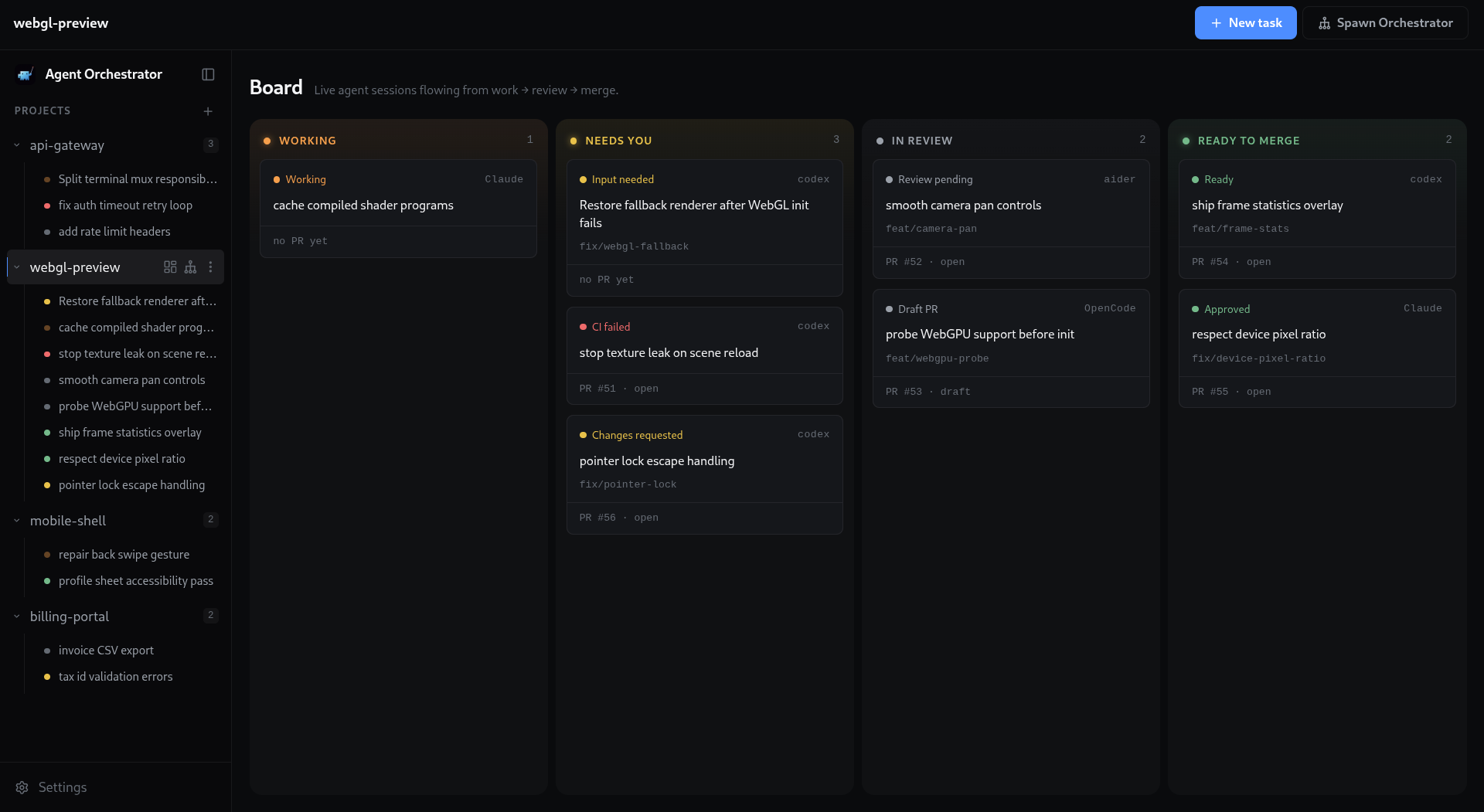
An Agentic IDE that supervises parallel AI coding agents in isolated workspaces, with complete control and automatic feedback loops from CI failures, review comments, and merge conflicts.
What is Agent Orchestrator?
Agent Orchestrator is a meta-harness agent IDE for running AI coding agents in parallel. It gives terminal-based agents like Claude Code, Codex, Cursor, Aider, Goose, and others a shared workspace where their sessions, terminals, branches, pull requests, and feedback loops can be supervised from one place.
The agents still do the coding. AO provides the harness around them: isolated workspaces, live terminal access, session state, PR awareness, and automatic loops that send CI failures, review comments, and merge conflicts back to the right agent. Instead of manually coordinating a pile of agent terminals, AO turns parallel agent work into a managed workflow.
Why Agent Orchestrator?
AI coding agents become much more useful when they can work in parallel, but parallel work gets messy quickly. Branches overlap, terminals get lost, CI failures need follow-up, review comments need replies, and merge conflicts have to reach the right worker.
Agent Orchestrator is built to keep that loop visible and manageable. It helps you:
- Start multiple agents from the same project without mixing their work
- Keep every session in a separate git worktree
- See which agents are working, waiting, finished, or blocked
- Route CI failures, review comments, and merge conflicts back to the right session
- Use different agent CLIs through one common supervisor
How it works
At a high level, Agent Orchestrator follows a simple loop:
- Add a project you want agents to work on.
- Start one or more sessions from the desktop app or CLI.
- AO creates an isolated git worktree for each session.
- AO launches the selected coding agent in that session's terminal runtime.
- The local daemon watches session state, terminal activity, pull requests, CI, and review feedback.
- The desktop app and CLI show the current state and let you send follow-up instructions to the right session.
The result is a local control layer for agentic coding: agents still do the coding, while Agent Orchestrator keeps their workspaces, status, terminals, and feedback loops organized.
Witness AO's Journey on X
 Visit |
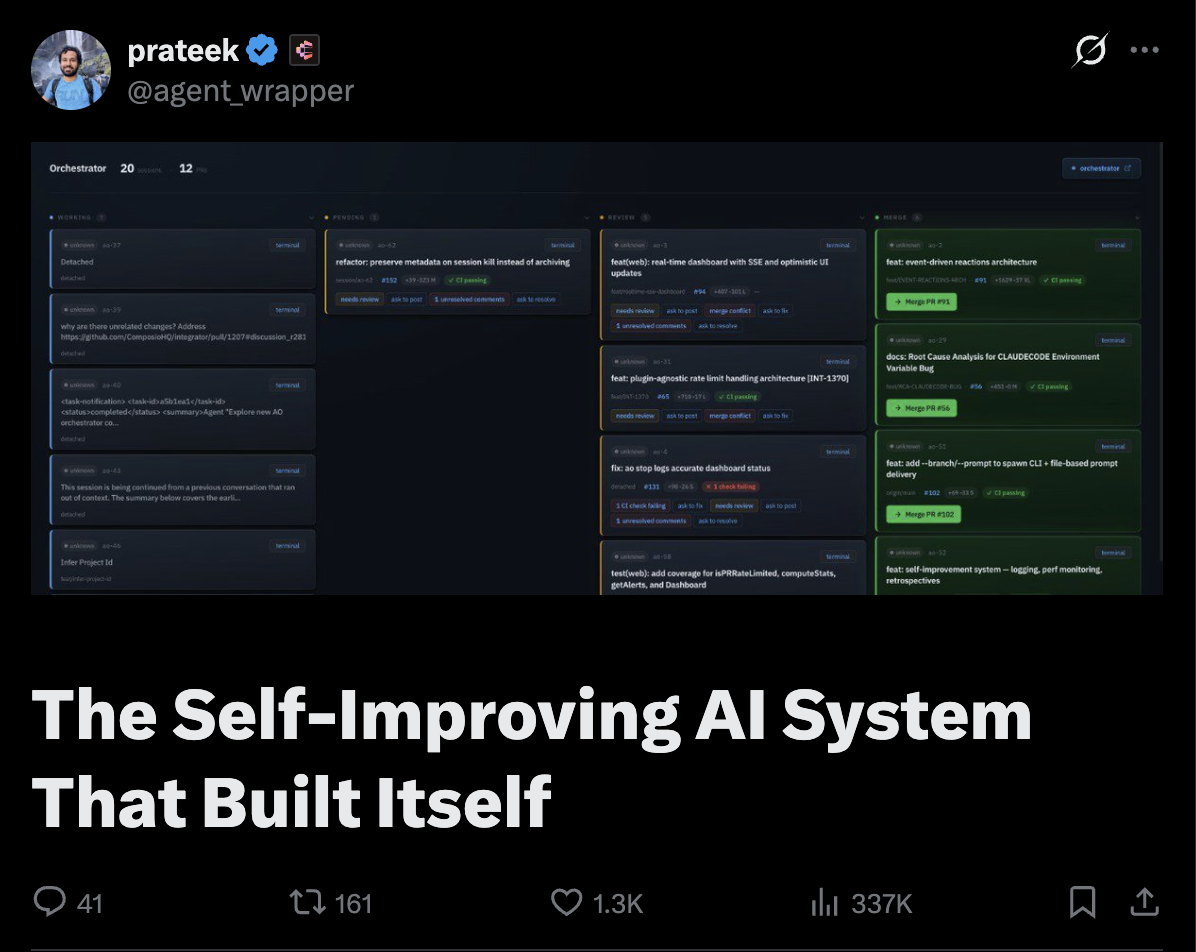 Visit |
 Visit |
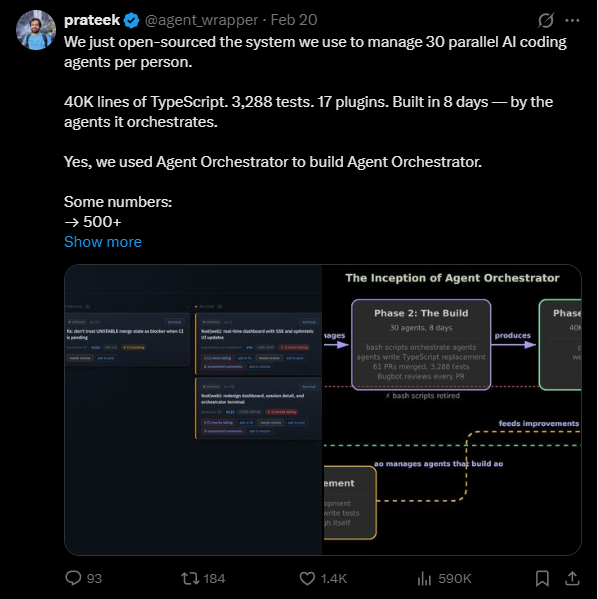 Visit |
What is Agent Orchestrator? • Why Agent Orchestrator? • How it works • Features • Quick Start • Architecture • Documentation • Contributing
Features
| Feature | Description |
|---|---|
| Agent-Agnostic Platform | 23+ agent adapters including Claude Code, OpenAI Codex, Cursor, OpenCode, Aider, Amp, Goose, GitHub Copilot, Grok, Qwen Code, Kimi Code, Cline, Continue, Kiro, and more |
| Isolated Workspaces | Each session spawns into its own git worktree with dedicated runtime |
| Platform-Native Runtimes | tmux on Darwin/Linux, conpty on Windows for optimal performance |
| Live PR Observation | Provider-neutral SCM observer with automatic feedback routing |
| Automatic Feedback Routing | CI failures, review comments, and merge conflicts routed to the owning agent |
| Durable Facts Storage | SQLite persists immutable facts with display status derived at read time |
| CDC Broadcasting | DB triggers append changes to change_log, broadcasted via SSE |
| Desktop Experience | Native Electron app with React UI and live terminal streaming |
| Loopback-Only Daemon | HTTP control over 127.0.0.1 with no auth, CORS, or TLS by design |
Supported Agents
Works with 23+ CLI-based coding agents including Claude Code, OpenAI Codex, Cursor, OpenCode, Aider, Amp, Goose, GitHub Copilot, Grok, Qwen Code, Kimi Code, Crush, Cline, Droid, Devin, Auggie, Continue, Kiro, and Kilo Code.
If it runs in a terminal, it runs on Agent Orchestrator.
Quick Start
Prerequisites
| Requirement | Minimum | Recommended |
|---|---|---|
| Go | 1.25+ | Latest |
| Node.js | 20+ | Latest LTS |
| Git | Any | Latest |
| pnpm | Any | Latest |
Optional:
tmux(Darwin/Linux) - For Unix runtimegh(GitHub CLI) - For authenticated GitHub API calls
Installation
Download the latest release for your platform:
| Platform | Download |
|---|---|
| Windows | Setup.exe |
| macOS | Agent Orchestrator.dmg |
| Linux | Agent Orchestrator.AppImage |
Direct Download: Latest Release
Telemetry
Agent Orchestrator collects minimal telemetry for reliability and product understanding. Data is stored locally by default; remote transmission is opt-in via environment variables. Read the full telemetry policy.
Architecture
Agent Orchestrator is a long-running Go daemon built around inbound/outbound port contracts with swappable adapters.
Core mental model: OBSERVE external facts → UPDATE durable facts → DERIVE display status / ACT
Key components:
- Frontend - Electron + React UI with TanStack Router/Query and shadcn/ui
- Backend Daemon - Go-based HTTP server with controllers, services, and adapters
- Runtime - Platform-specific:
tmuxon Darwin/Linux,conptyon Windows - Storage - SQLite with change-data-capture (CDC) for real-time updates
- Adapters - 23+ agent adapters, git worktree workspace, GitHub SCM integration
For detailed architecture diagrams, data flows, and load-bearing rules, see architecture.md.
Documentation
| Document | Description |
|---|---|
| Architecture | System architecture, data flows, and load-bearing rules |
| Backend Code Structure | Package-by-package ownership and dependency rules |
| AGENTS.md | Contributor and worker-agent contract |
Testing
# Backend tests
cd backend
go test -race ./...

# Frontend tests
cd frontend
pnpm test

# Full CI validation locally
npx @redwoodjs/agent-ci run --all
Configuration
All configuration is environment-driven. The daemon takes no config file.
| Variable | Default | Purpose |
|---|---|---|
AO_PORT |
3001 |
HTTP bind port |
AO_REQUEST_TIMEOUT |
60s |
Per-request timeout |
AO_SHUTDOWN_TIMEOUT |
10s |
Graceful shutdown cap |
AO_RUN_FILE |
~/.ao/running.json |
PID/port handshake |
AO_DATA_DIR |
~/.ao/data |
SQLite data directory |
AO_AGENT |
claude-code |
Compatibility agent adapter |
GITHUB_TOKEN |
- | GitHub auth token |
Health Checks
curl localhost:3001/healthz   # Liveness probe
curl localhost:3001/readyz    # Readiness probe
Contributing
We love contributions! Join our community on Discord to get started.
Join us on Discord



Daily contributor sync: Every day at 10:00 PM IST
Get your issues verified by core contributors, ask questions, share progress, and learn from the community. New contributors are always welcome!
Why join Discord?
- Get your issues and PRs verified by core contributors before investing time
- Learn from experienced contributors in daily sync calls
- Share your progress and get feedback
- Get help troubleshooting in real-time
- Stay updated on the latest developments and roadmap
Quick Start
- Join the Discord - Connect with the community and get guidance
- Read the contributor contract - See AGENTS.md for repo layout, daemon/API boundaries, and coding conventions
- Pick a focused problem - Browse open issues and choose one small enough for a focused PR
- Open a clear PR - Keep changes narrow, explain user-visible impact, link issues, include tests
- Iterate with contributors - Use review feedback to tighten the PR until verified
License
Apache License 2.0 - see LICENSE for details.
Star us on GitHub • Report Issues • Discussions
Made with love by the Agent Orchestrator community